Deep In the Night Kitchen: On Childhood and Authors

I’ve been thinking about authors today, particularly Maurice Sendak, who died today.

I’ve been thinking about authors and how children relate to them, or rather, how I related to them as a child.

Today, I watched Sendak on the Colbert report. It was Sendak’s last interview.  It is a thing of wonder, and it was amazing to me to see Sendak and his honest and curmudgeonly personality. I imagined showing the clips to kids who more recently had discovered Sendak. I realized they wouldn’t care.

Obviously, there are some children who are interested in the author. All the children who wrote to Sendak, for example. I am sure that, if prompted, I would have written to an author or two as a child. After all, I wanted to be an author.

But, the only memory I have about authors as a child was my discovery that not only had I read all of Edward Eager’s books but that he was dead and would write no more. The disappointment had nothing to do with Eager’s death 30 years prior, it had to do with the fact that there would be no more of those magical books, and that was quickly put aside when I learned his favorite author was E. Nesbit. It wasn’t the bit of biography, it was the book recommendations that were important.  Even when I knew about an author–I knew that Roald Dahl may have been anti-Semitic–my knowledge had no bearing on my enjoyment of the books. The only thing that mattered was: is the author alive? Will there be more if I run out?

Today, as an adult, I still haven’t met very many of my favorite authors. I learned an immense amount about creative writing from Mary Gordon, but I only read (and loved) her books once I had already met her as my creative writing professor. I can only think of one other fiction book signing I have attended (Jasper Fforde. Thankfully, he was hilarious in person too. (Thankfully? Why should I care? But I do believe I would have been disappointed).

I once wanted to write to Joyce Carol Oates after she wrote that she likes to think her students at Princeton has not read her writing. It seemed so preposterous. Not read her writing?

“I’ll write to her,” I thought. “I will tell her that  We Were the Mulvaneys was the first book not written for children that I remember that I chose to read without any input, guidance or recommendations from adults. That her books shaped my transition into adulthood and changed my ideas about what it was allowed to do with language.”

But, of course, I didn’t. Still, now, I want to know more about the authors I love. I love reading about the craft of writing. I follow Margaret Atwood on Twitter.

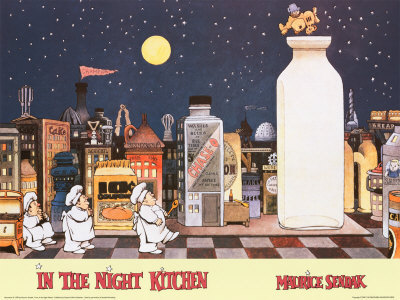
So, what is it about childhood authors? I think it is the sense of experience that is somewhat lost in adulthood. When I remember In the Night Kitchen, Where The Wild Things Are, and Pierre I remember them with fondness and a sense of safety that is not reflected in the text of the books. It comes from being read to. When I listened to a recording of In the Night Kitchen today, I heard my father’s voice even as another voice read the lines “I am not the milk, and the milk’s not me! I’m Mickey!” Reading  was an entirely immersive experience. It didn’t matter who the author was, because he was not part of my world at the moment. That world was contained in the book and in my parent’s lap. Later, when I was reading to myself, the book itself sufficed.

On the best days now, I can read for long enough and with enough intensity that the outside world–author and all–fade to nothing.

I have loved reading about Sendak’s life today. I was honestly sad to hear he had died, but I have to admit that the sadness was surely selfish, sadness  that a man who had created worlds of my childhood had died. That there would be no more books. After all, when we say someone was a “beloved children’s book author” isn’t it usually the books that are beloved? The worlds that are created?

Sendak offered so many worlds, and a lot more. Now, too late, I write to him:

Thank you, Maurice Sendak for the adventures, the escapes, the immersions into places and experiences both so recognizable and exotic.

A Word of Advice For Those Who Google

I’m not really an advice type of person, but my back-end stats, tell me that someone found this blog because she (I assume given the school) had googled “making friends at Barnard.” I hope it was someone who is in the position I was in five years ago. Five years ago, right around this time, I was struggling to write my senior column for the Columbia Daily SpectatorI had no idea how to write about the importance of the moments I had experienced, the lessons I had learned, and the friends I had made at the paper, at Barnard, and at Columbia University. I am sure I googled all sorts of things in an attempt to find inspiration.

But, I am a realist, so I figure the woman who googled “making friends at Barnard” is looking for tips or is a prospective student wondering how hard it is to make friends at college. To those women, I say: join a club. Any club or activity that you think might interest you. Try out a few and stick with only the ones that make you feel happy and whose mission you believe in. Dive into it, even if if means letting your grades drop a bit. You will find camaraderie in the commitment.  Join for the activity, stick it out for the experiences, and eventually, you’ll stay for the friends.

When my senior column was finally written and was published, a friend who was not on the paper came up to me and said “I read your column; it made me jealous. I wish I had found a place like that.” I was taken aback because this is a kid I generally considered popular and outgoing with no shortage of community. In college–perhaps especially in New York City–commitment can look like obsession and can feel like sleep deprivation, but in the end it manifests itself as a community of friends.

The Crystal Ball is Really Murky

I want to believe that news has a future. I don’t mean that things will continue to blow up, countries will continue to go to war, celebrities will continue to stumble, and people will continue to invent and discover.

That news of course, does have a future in that their will always be things people want to know about. I also have faith that those kind of things–the war, and crime, and inventions–will get passed on from the newsmakers to everyone else without much trouble. That’s the kind of news that can be passed on with a release or a tweet. Community boards can start their own newsletters or blogs. Even some of the really big news can come straight from the source through the Internet. And, if we see newspapers as the way that people found out what was going on in the world, then newspapers probably are obsolete.

But newspapers are more than that. It’s not enough to know war broke out; people should know what happens in that war, what leads to things going terribly wrong as well as what is going right. Cold cases should come back in the public eye. Industry deception and hidden dangers should be revealed. The news from the mouth of the source should be weighed against opposing views. That’s the kind of stuff that journalism provides, and that can’t always be replaced with the mess of ways to communicate that the Internet provides.

Of course, those stories are generally expensive, and, as Nick Carr points out, were previously funded by bundling. Carr’s article did an excellent job laying out the problems with the industry’s over-reliance on bundling. But he ends his post by saying that quality journalism might just die. He offers no solution to the very real problem.

I was heartened, however, by the underlying message in Jeff Jarvis‘ post, even though I remain skeptical of it’s most obvious point:

I’ll say it again: Distribution is not king. Content is not king. Conversation is the kingdom. It’s about relationships.

I believe that it’s somehow about relationships, but I’m still not sure how the community interaction part plays in. The Boston Globe is betting on the True Fans model: people who just need their Red Sox fix can get it for free, but people who love the Globe–for it’s reporting on non-sports, or for other, more emotional reasons–will pay for it at BostonGlobe.com. Not coincidentally, BostonGlobe.com is also where they intend to have their most vibrant commenting system. But, I think that relationships and conversation are two different things.

I have a relationship with the Globe. My very first byline was on a book review for the Globe‘s long-gone Student Page. I was nine years old. The Globe is My Hometown Newspaper, so when they told me I’d have to pay for access, I did. But I don’t have a conversation with the Globe. I rarely comment on newspaper articles; I can’t imagine my Globe subscription will change that.

When I asked the publisher of the Globe, Christopher Mayer, what value he foresaw getting from a BostonGlobe.com commenting system, he talked about community, and feedback and solid reader contributions, driven by the fact that readers would not be able to hide under full anonymity (at least the subscription sale people know who you are no matter how strange your commenting handle is). Maybe that can all be monetized, and maybe he didn’t want to tell me how that would be monetized (the answer might be offline–the Globe will be offering that same commenting community in-person events), but right now I don’t see how communication leads to money, or certainly not to the money needed to make up for the unbundling. That being said, I’m not sure the True Fans model will make enough money for that either. I don’t think shorting stocks or “”scooping the muck from the sewer and holding it up in your hand and saying, ‘Look at this. Smell this””  is the answer either.

I’m skeptical of conversation as kingdom–though I recognize that might be because so many sites add commenting as a tack-on rather than a thought-through part of their site and business model–but what really struck me about the Jarvis was that he pushed the idea that newspapers need to figure out what their value is. He argues that it’s community or conversation. I’d say it’s providing information beyond the basics.

But, I do think that newspapers don’t often enough step outside of the journalism bubble and ask what their value can and should be in the Internet age. It might be some sort of smart aggregation. It might be letting computers write the breaking news so that staff can only focus on investigation. It might be becoming the virtual town square. I think that that answer needs to be found first before the solution to the money problem can really be found.